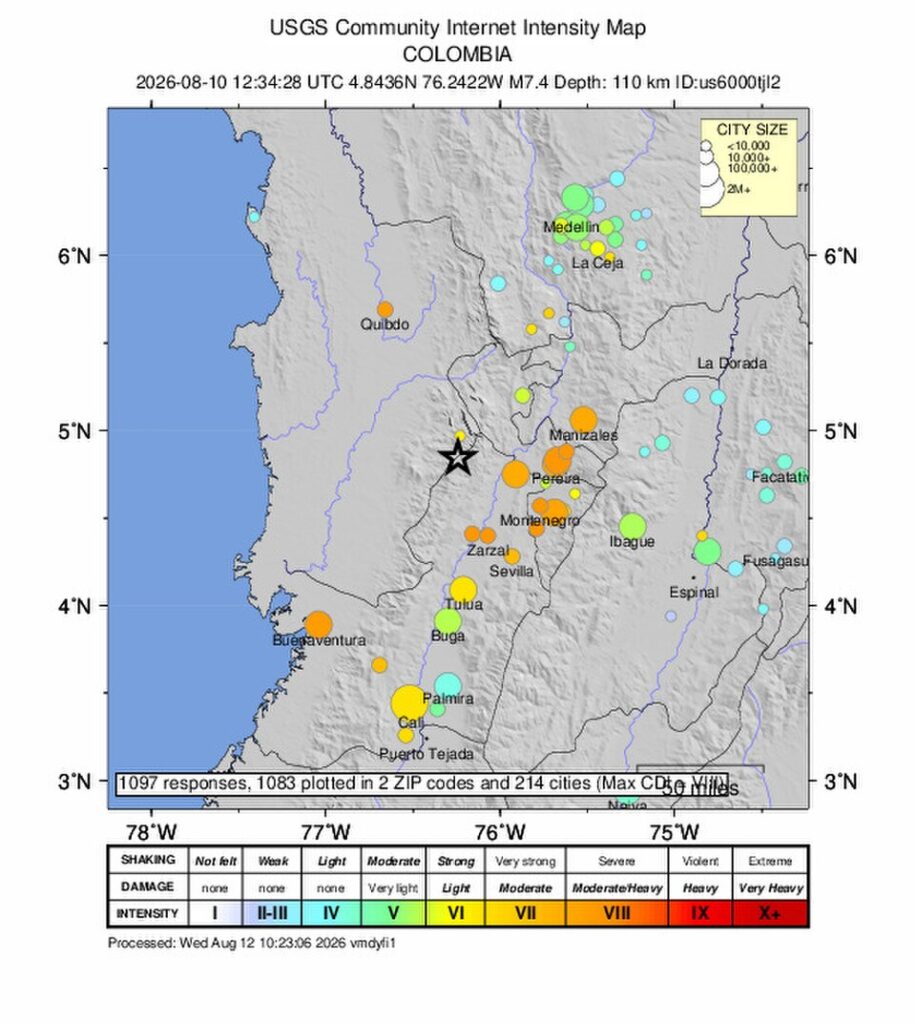
Manizales Mayor Jorge Eduardo Rojas confirmed this week that the city has received thousands of requests to formally assess earthquake-damaged homes — a process officials say will take at least a month to complete. This single-city data point is a precise illustration of the realistic pace of post-earthquake recovery: the gap between the moment the shaking stops and the moment families know whether their homes are safe to return to is measured in weeks. Multiply Manizales by every affected city and municipality across Colombia, and the scale of the administrative recovery challenge becomes clear.

WHAT A FORMAL DAMAGE ASSESSMENT INVOLVES
Earthquake damage assessments — known in emergency management as Rapid Damage Assessments or RDAs — require trained engineers or building inspectors to physically visit each affected structure, evaluate its structural integrity, and assign a color-coded status:
▸ GREEN — safe to occupy; no significant structural damage
▸ YELLOW — limited occupancy or restricted entry; structural damage present but building not at immediate collapse risk
▸ RED — unsafe; do not enter; building is at risk of collapse or has collapsed
The color tagging system determines whether residents can return to their homes. A yellow or red tag means displaced families remain displaced — in shelters, with relatives, or in temporary housing — until either repairs are made and the tag is upgraded or the building is demolished. For thousands of Manizales families, the month-long assessment timeline means at least a month of displacement uncertainty.
WHY A MONTH IS ACTUALLY FAST
A month to complete thousands of damage assessments is not slow by post-earthquake standards; it is fast for a city that has probably never trained or deployed damage assessors at this scale before. The assessment requires qualified personnel — engineers and building inspectors — who must physically visit each structure. Manizales does not have an unlimited supply of trained assessors; they must work systematically through thousands of addresses.
For context: after the 2010 Christchurch, New Zealand earthquake, damage assessments for the city’s 160,000 properties took approximately three years for the full program to complete. After the 1994 Northridge, California earthquake, assessments of 600,000+ structures took weeks just for the initial rapid phase. A month for thousands of Manizales homes is an ambitious target.
A month is fast. It does not feel fast if you are displaced and waiting to know whether you have a home to return to.
THE CASCADING TIMELINE
The damage assessment is not the end of the recovery process — it is the beginning of the formal one. After assessment: yellow-tagged buildings require engineering review to determine repair scope; repair requires contractors and materials; insurance claims require assessment documentation; relief payments require assessment documentation; demolition of red-tagged buildings requires government authorization. Each step in this cascade takes additional weeks to months. The full recovery timeline for Manizales is measured in years, not months.
| CONFIDENCE: HIGH | Mayor Rojas’ month-long assessment timeline is from confirmed reporting. Rapid Damage Assessment process and color-coding system are from established FEMA and international emergency management documentation. Comparison timelines (Christchurch 3 years, Northridge weeks for initial phase) are from established disaster recovery records. |
SOURCES
▸ Manizales Mayor Jorge Eduardo Rojas — damage assessment timeline statement
▸ FEMA Rapid Damage Assessment documentation — established emergency management