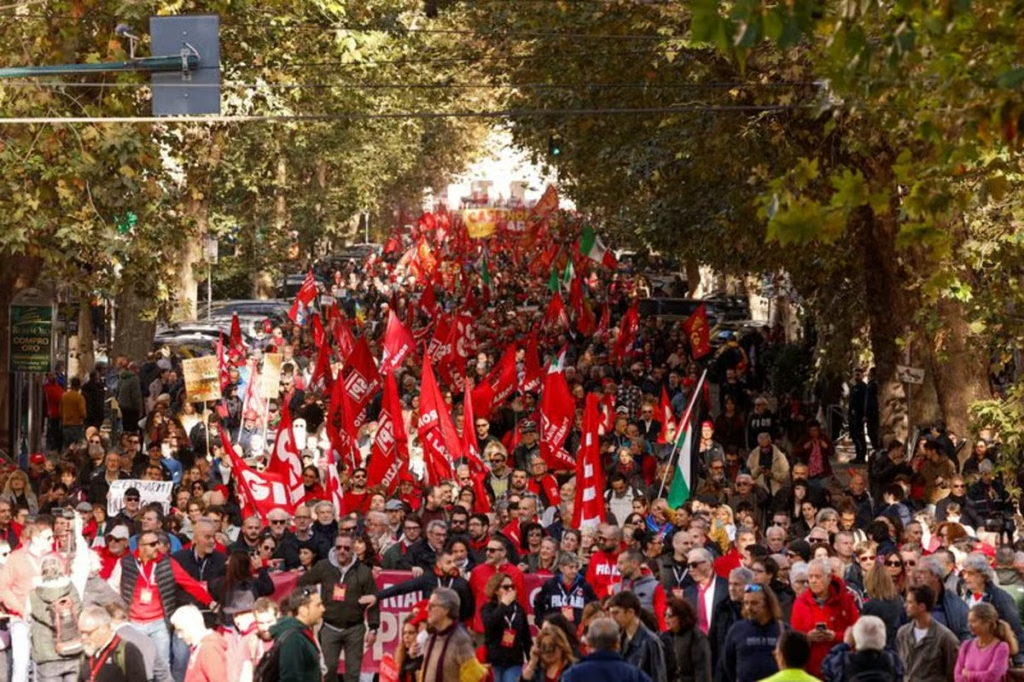
The economic and social impact of the Italian nationwide strikes that began on November 20 continued to be felt across the country, as follow-day reporting documented the specific disruptions and the government response to the labor action.
ITALY · STRIKES · CONTINUED IMPACT · WAGES · LIVING COSTS · WORKERS · STUDENTS · ARC
The economic and social impact of the Italian nationwide strikes documented in ONYX November 20 continued to be felt across the country on Friday, as follow-day reporting from the Associated Press and Euronews documented the specific disruptions, the government response, and the state of the ongoing labor-government standoff over wages and cost of living. The strikes — which had brought out workers and students in more than 100 cities on November 20 — did not end with the November 20 day of action; in some sectors, work stoppages continued into the following day, and the broader economic impact of the November 20 action was being assessed across the transportation, education, and public services sectors that had been most affected. The AP and Euronews noted that the Italian government had not offered any immediate response to the union and student demands that would change the fundamental standoff.
Euronews provided the most detailed follow-up reporting on the specific disruptions and their geographic spread. Train delays and cancellations continued in some regions where rail workers had extended their work stoppage beyond the November 20 day of action, and airports in some Italian cities were still managing the backlog from flights cancelled or delayed during the November 20 action. Schools that had been closed by teacher participation in the strike were reopening in most areas, though the student organizations reported that some schools remained affected by student boycotts separate from the teacher action. Euronews noted that the Rome and Milan transportation systems — the two largest urban systems in Italy — were returning to normal operations on Friday, though with residual delays from the previous day’s disruptions.
The Government Silence
The AP analyzed the government silence dimension of the follow-day situation. The Italian government under Prime Minister Giorgia Meloni had not issued any formal response to the November 20 strike demands by the time of Friday reporting, and union leaders were characterizing the government silence as evidence that the government does not take the labor movement concerns seriously. The AP noted that the government strategy appears to be to allow the immediate energy of the strike action to dissipate without offering any concessions that would validate the action, in the expectation that the unions will face the standard union dilemma: escalate with further and more disruptive action, or accept that the government is not moving and declare the November 20 action a statement of principle rather than a demand that produced results. The AP noted that the union leadership has signaled it is prepared to escalate, but that the specific form and timing of any further action had not been announced.
“The government has said nothing. That is their answer. Our answer will be more action.” — CGIL union leader cited by Euronews on the follow-day situation
The European Labor Context
Euronews placed the Italian follow-day situation in the broader European labor context. The Italian strikes are part of a pattern of European labor action that has been building throughout 2026 as the wage and cost-of-living pressures documented in the November 20 coverage continue to generate worker and union frustration. Euronews noted that similar strike actions have occurred or are planned in Germany, France, and Belgium in the November-December period, and that the European trade union movement is increasingly treating the wage-cost-of-living issue as a pan-European labor rights challenge rather than a series of separate national disputes. The European Trade Union Confederation has called for coordinated European-level action on wages and cost of living, and the Italian strikes are the most visible current manifestation of that broader movement.
WHAT HAPPENS NEXT
► Italian government to respond or maintain silence; whether any concessions are offered to reduce labor tension
► Union leadership to announce next action; whether a second strike wave is called and when
► Transportation and education sectors to fully restore normal operations; residual disruptions to clear
► European Trade Union Confederation to coordinate next steps; whether Italian action triggers broader European response
| CONFIDENCE: MODERATE | Associated Press and Euronews confirmed the continued strike impact, the government silence, and the European labor context. Two-source confirmation on a follow-day update — moderate confidence reflects the arc continuation nature of the story with limited new primary developments. |
| Bias Check | ||
| Left-Lean | Center | Right-Lean |
| Government silence framed as contempt for workers; Meloni is hoping the labor movement loses energy rather than engaging with legitimate demands. | Reports continued disruptions, government silence, union response, and European labor context factually. | Government silence framed as responsible fiscal management; conceding to strike demands would worsen Italy’s budget position and harm all Italians. |
SOURCES
► Associated Press — Follow-day disruption assessment, government silence analysis, union escalation signals, November 21, 2026
► Euronews — Specific disruption detail, transportation and education recovery, European trade union context