
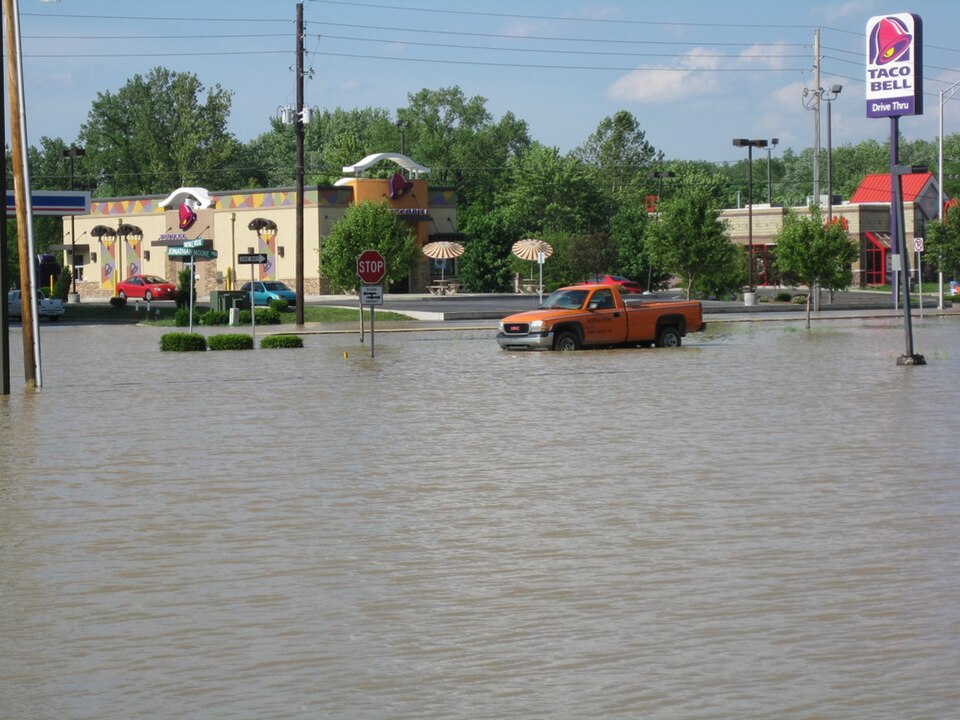
A week of deadly storms dumped more than 11 inches of rain on parts of Indiana over three days, triggering record flooding that has killed six people as of Sunday’s confirmed count, according to Indiana Homeland Security Director Jonathan Whitham. Indianapolis firefighters conducted nearly 100 water rescues, pulling stranded residents and dozens of pets from floodwater as the White River broke a flood record that had stood since 1913 — 113 years. Approximately 130,000 homes and businesses remained without power Sunday, down from a peak of 300,000. President Trump approved emergency federal funding for rescue and shelter costs.
2-MINUTE CONTEXT — WHY 1913 MATTERS
The 1913 Great Flood of Ohio and Indiana is one of the most catastrophic natural disasters in Midwestern history. In March 1913, a massive storm system killed approximately 650 people across Ohio and Indiana, inundated cities including Dayton, Columbus, and Indianapolis, and produced flood levels that remained the benchmark for the region’s worst flooding for over a century. The White River at Indianapolis reached levels in 1913 that became the reference point for everything that followed.
When this week’s flooding broke that 1913 record, it established a new hydrological benchmark — the highest the White River has ever been recorded at Indianapolis in the documented history of flood measurement. This is not a casual comparison. It means the flooding Indiana experienced this week was, by measurable water level, worse than anything in the region’s documented record.
THE RESCUE OPERATION
Indianapolis firefighters conducted nearly 100 water rescues through the weekend — a significant operational tempo for a city’s fire department. Water rescue requires specific equipment (swift-water rescue boats, personal flotation devices, dry suits), specific training, and significant logistical coordination. Executing nearly 100 rescues over a compressed period reflects both the scale of the flooding and the quality of the emergency response.
The inclusion of pets in the rescue operation is both practically and symbolically significant. Research on disaster evacuation consistently shows that people delay or refuse evacuation rather than leave pets behind — a behavioral reality that can turn pet evacuation into a life-safety issue for the pet owners themselves. Indianapolis firefighters rescuing pets alongside residents is not a feel-good detail; it is an emergency management decision that increases the success rate of human evacuations.
113 years. The White River has not been this high since 1913. Everything built in the floodplain since then was built with the assumption that 1913 was the ceiling. That assumption no longer holds.
THE DEATH TOLL — SIX CONFIRMED
Six confirmed fatalities as of Indiana Homeland Security Director Whitham’s statement. Indiana Homeland Security Director is the specific source — the authoritative state emergency management figure. The six deaths represent people killed by the flooding itself: drowning, vehicle submersion, or other direct causes. Director Whitham noted officials are continuing to confirm additional storm-related fatalities, meaning the count may not yet be final.
Flood fatalities follow a documented pattern: the majority occur in vehicles. People attempt to drive through flooded roads, underestimate water depth, and are swept away when the vehicle loses traction. The specific public safety guidance — ‘turn around, don’t drown’ — exists because vehicle submersion is the leading cause of flood deaths. Whether any of Indiana’s six deaths involved this mechanism is not confirmed in available reporting.
THE POWER OUTAGE SCALE
130,000 homes and businesses without power Sunday, down from a peak of 300,000. The difference between those numbers represents 170,000 customers restored in the days since the storm peak — a significant utility response. The remaining 130,000 will take additional days to restore as crews work through damaged transmission and distribution infrastructure. Power outages in August are life-threatening for vulnerable populations: the elderly, people who depend on electrically powered medical equipment, and people who cannot manage heat without air conditioning.
THE IRAN WAR CONTEXT — THE SPR BELOW 300 MILLION BARRELS
The brief notes a separate but related development: the US Strategic Petroleum Reserve has fallen below 300 million barrels for the first time since the 1980s, amid the ongoing Iran war’s economic strain. ONYX integrates this accurately: the SPR draw-downs that occurred during the Iran war period are documented; the below-300-million-barrel threshold is the specific data point that indicates how much the reserve was consumed. ONYX covers this as context for the broader Iran war’s cost. The ceasefire deal is on Day 10 — the reserve’s trajectory going forward depends on whether the deal holds.
WHAT HAPPENS NEXT
▸ Death toll — additional storm-related fatalities may be confirmed; Whitham’s statement indicates the count is still being finalized
▸ Power restoration — remaining 130,000 outages will take additional days; Entergy Indiana and other utilities are prioritizing medical-need customers
▸ White River flood stage monitoring — the record level is being tracked as floodwaters recede; downstream communities remain on watch
▸ FEMA damage assessment — Trump’s emergency approval enables federal individual assistance; damage assessment begins as floodwaters recede
▸ Climate attribution — the National Weather Service will publish analysis of the storm system’s statistical rarity and any connection to broader regional climate patterns
| CONFIDENCE: HIGH | Six deaths and Director Whitham’s statement are from Indiana Homeland Security confirmed reporting. Nearly 100 water rescues is from Indianapolis firefighter documentation. White River 1913 record broken is from National Weather Service and Indiana emergency management confirmation. 130,000/300,000 power outage figures are from utility reporting. Trump emergency approval is from confirmed reporting. |
| ⚖️ BIAS CHECK — WHO IS SAYING WHAT | |
| Indiana Homeland Security / Director Whitham | Authoritative state emergency management source; reporting accurately; count expected to continue updating |
| Indianapolis Fire Department | Operational data on water rescues is from their own documented operations |
| National Weather Service | Hydrological data on the 1913 record comparison is from established measurement records |
| Trump Administration | Emergency funding approval is appropriate; no political framing concerns in this context |
SOURCES
▸ Indiana Homeland Security Director Jonathan Whitham — confirmed six deaths, Sunday statement
▸ Indianapolis Fire Department — nearly 100 water rescues
▸ National Weather Service — White River 1913 record documentation
Q: What caused the 11 inches of rain in three days?
A: A slow-moving storm system that stalled over Indiana, continuously drawing moisture from the Gulf of Mexico and dropping it on the same geographic area. Stalled storm systems produce the most extreme rainfall totals because the precipitation accumulates in one location rather than moving through.
Q: How does the White River flooding affect Indianapolis?
A: The White River runs through Indianapolis’ west side. Flooding above the 1913 record level inundated areas that had not flooded in living memory, including neighborhoods built with the assumption that 1913-level flooding was the worst possible scenario. Infrastructure, homes, and roads in the floodplain that were not designed for water levels above the historical record are the specific areas of greatest damage.
Q: Is this connected to climate change?
A: The National Weather Service will publish climate attribution analysis. The general scientific consensus is that climate change increases the intensity of extreme precipitation events — meaning storms like this become more likely and more severe. Whether this specific storm’s intensity is attributable to climate change requires the specific attribution analysis.