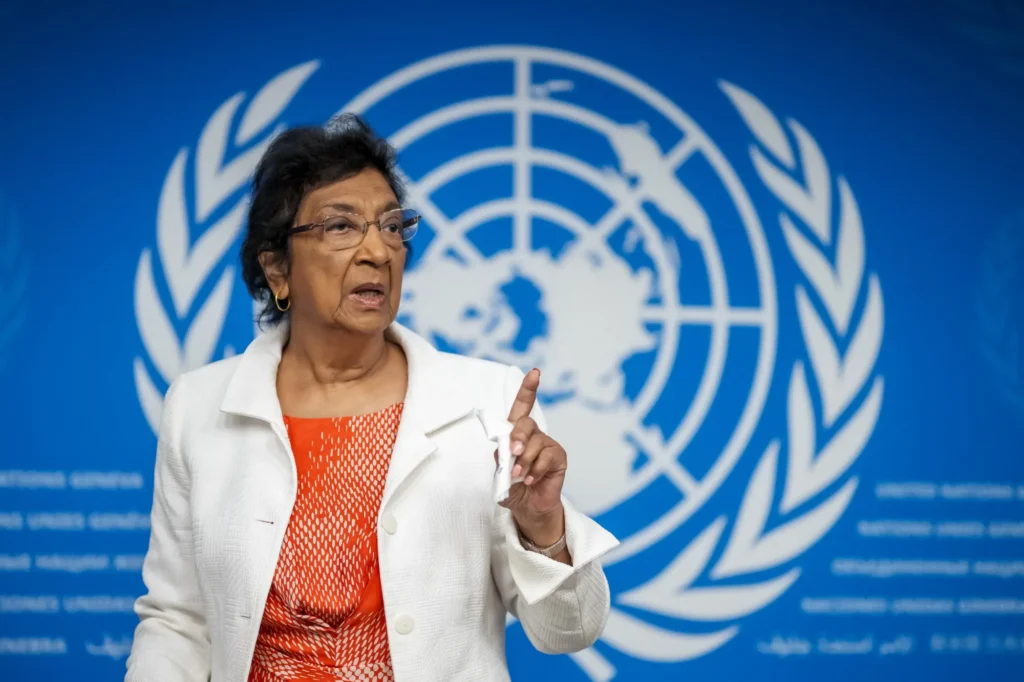
Navi Pillay, South Africa’s former UN human rights chief, won the 2026 Nobel Peace Prize. The President of the United States said he’d never heard of her. She said she’d share the prize if applause kept coming.
🏅 OSLO · OCTOBER 10, 2026 · NOBEL PEACE PRIZE
The Nobel Peace Prize is, among the things it is, a provocation. It has been one since the committee gave it to a Vietnamese diplomat the United States had been bombing, since it went to a Palestinian leader America was simultaneously pressuring to make concessions, since it recognized an organization that the United States had just withdrawn from. This year’s choice — Navi Pillay, the South African jurist who served as the UN High Commissioner for Human Rights from 2008 to 2014 and who has spent her career arguing that international law applies uniformly, regardless of who is violating it — is a provocation of a specific and contemporary kind.
The Norwegian Nobel Committee announced Pillay as the 2026 laureate for her decades of work promoting international law, prosecuting war crimes and genocide, and building the institutional framework of international human rights accountability. The committee’s framing was clear: this is a prize for the idea that no government, however powerful, is exempt from international legal standards. Donald Trump’s reaction was also clear: he called the decision an “indelible stain” on Norway, said he had never heard of Pillay, and argued that the prize should have gone to the United States or to him.
WHO NAVI PILLAY IS
Pillay’s career is, in the literal sense, a story of international human rights law built from the inside. She grew up under apartheid in South Africa, became one of the first Black women to practice law in KwaZulu-Natal, served as a judge on the International Criminal Tribunal for Rwanda, where she helped develop legal precedent on genocide and sexual violence as a war crime, and was later elected President of the International Criminal Court before her appointment as UN Human Rights Commissioner.
Her tenure at the UN Human Rights Council was marked by her willingness to criticize governments that considered themselves allies of the international order — the United States, Israel, Russia — with the same language she applied to governments that were more obvious targets. That evenhandedness made her simultaneously admired by international law advocates and deeply unpopular with governments that prefer selectivity in human rights accountability.
TRUMP’S RESPONSE AND WHAT IT REVEALS
Trump’s reaction — “I’ve never heard of her” followed by “this is a stain on Norway” — is not merely a personal slight. It is a statement of policy: that the United States under this administration does not recognize the legitimacy of international human rights institutions to confer prestige on people who have applied accountability standards to the United States. That position has been consistent since 2025 and is not a surprise. Its expression in the context of a Nobel Prize is a theatrical sharpening of a position that was already clear.
Pillay’s response — that she would share the prize if the applause kept coming — was noticed as the exact right note. It acknowledged the absurdity of the moment without descending into it; whether she learned that composure from four decades of arguing in international courts against governments with much larger armies than Norway is left as an exercise for the reader.
“The Prize went to a woman who spent her career arguing that powerful countries are not exempt from international law. The most powerful country’s leader said he’d never heard of her. The committee probably expected something like this.”
WHAT HAPPENS NEXT
► Nobel ceremony — December 10 prize ceremony in Oslo; whether Trump administration sends a representative
► ICC implications — whether the prize emboldens or complicates ICC efforts on pending cases
► US-Norway diplomatic temperature — whether Trump’s “indelible stain” remark produces a formal Norwegian response
| CONFIDENCE: HIGH | NobelPrize.org, BBC, NYT, Reuters, CNN confirmed Pillay as 2026 Peace Prize laureate. Trump statement confirmed across multiple outlets. Pillay applause remark confirmed. |
| BIAS CHECK | ASSESSMENT |
| Source weight | NobelPrize.org primary; BBC, NYT, Reuters, CNN — maximum-tier corroboration |
| Trump framing | Quotes reported accurately; described as policy position, not personal eccentricity |
| Pillay framing | Career described factually; the “contested” characterization reflects documented political reality |
SOURCES
► NobelPrize.org — 2026 Peace Prize announcement, Navi Pillay, October 10, 2026
► BBC — Pillay biography and career summary, October 10, 2026
► The New York Times — Trump response and international reaction, October 10, 2026
► Reuters — Nobel committee statement and Pillay response, October 10, 2026