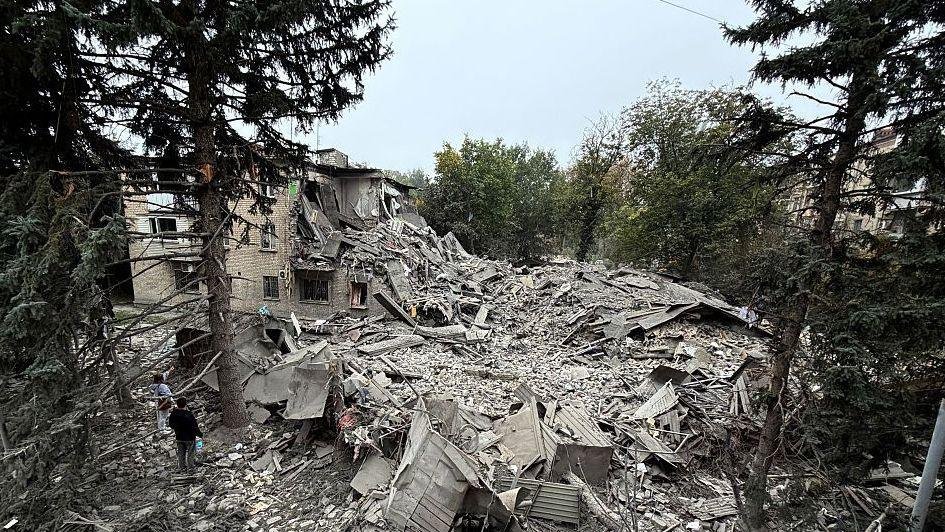
At least fifteen people were killed, including children, when Russian aerial bombs hit residential buildings in Ukraine’s Zaporizhzhia region. The timing, one day after Trump’s diesel agreement with Putin, was not lost on Kyiv.
🇺🇦 ZAPORIZHZHIA · OCTOBER 10, 2026 · RUSSIA STRIKES
At least fifteen people died in Zaporizhzhia on Saturday when Russian aerial bombs struck residential buildings. Among the dead were children. The strikes hit neighborhoods — not military installations, not industrial targets, not dual-use infrastructure — in the kind of attack that international humanitarian law exists specifically to prohibit and that has been occurring in Ukraine with regularized frequency since the war began.
Ukrainian President Zelensky made the connection to the diesel deal immediately. He said that Russia had interpreted the Trump-Putin economic agreement — and the signal it sent about American tolerance for Russian energy revenue — as permission to escalate. “They see an easing of pressure,” he said, “and they use it.” Whether that connection is causal in a strict sense or whether Zaporizhzhia was already on the strike schedule is a question that cannot be answered from available evidence. But Zelensky’s argument is not that the strikes happened because of the diesel deal. It is that the strikes happen when Russia believes the international community will tolerate them. And that the diesel deal is a data point in that calculation.
THE ZAPORIZHZHIA REGION
Zaporizhzhia sits in southeastern Ukraine in contested territory that has been subject to Russian missile and aerial bomb strikes for the duration of the war. The region includes Europe’s largest nuclear power plant — seized by Russian forces in March 2022 and a source of ongoing safety concern — as well as significant civilian populations that have not been evacuated and do not wish to be. Living in a strike zone is the condition that millions of Ukrainians have normalized because the alternative — displacement, loss of home, loss of community — is a cost they are not willing to pay.
The children who died in Saturday’s strikes were not statistics before they became statistics. They were in residential buildings when aerial bombs — not precision munitions, not tactical strikes on military targets, but bombs dropped on neighborhoods — hit those buildings. That is the mechanism. It should be stated plainly.
THE DIPLOMATIC CALENDAR
Saturday’s strikes occurred on the same day that US envoys were in Miami discussing Ukrainian peace proposals, the same day the British Foreign Minister was in Kyiv announcing sanctions, and the day after the American president agreed to buy diesel from the country doing the bombing. That calendar is not a coincidence of scheduling. It is the condition under which the war is currently being prosecuted: military operations continue while diplomatic conversations also continue, and the two tracks do not pause for each other.
Zelensky’s use of the strikes to argue against the diesel deal is both a moral argument and a strategic one. He is asking the international community — and specifically the American public — to hold two things in their minds simultaneously: the fuel price reduction that the diesel deal might or might not produce, and the children in Zaporizhzhia. He believes those two things are related. He wants others to believe it too.
“Children died in Zaporizhzhia the day after Trump announced a diesel deal with the country, dropping bombs on them. Zelensky said it was cause and effect. The administration said it was a fuel supply agreement. They can both be right.”
WHAT HAPPENS NEXT
► Casualty count — final toll as rescue operations in Zaporizhzhia complete
► International response — whether the strikes produce formal condemnations that reference the diesel deal
► US reaction — whether the administration responds to Zelensky’s cause-and-effect framing
► Ukraine weapons request — whether Kyiv escalates its requests for air defense in response
| CONFIDENCE: HIGH | CBS News, CBC News, and AP confirmed at least 15 killed, including children, in Russian aerial bomb strikes on Zaporizhzhia residential buildings. Zelensky reaction confirmed across multiple outlets. |
| BIAS CHECK | ASSESSMENT |
| Source weight | CBS, CBC, AP — multi-outlet confirmation of strikes and casualties |
| Zelensky argument | Reported accurately as stated argument, not independently verified causal claim |
| Strike characterization | Residential targeting and child casualties described factually per confirmed reporting |
SOURCES
► CBS News — Zaporizhzhia strikes, casualties including children, October 10, 2026
► CBC News — Russia aerial bomb attack residential buildings, October 10, 2026
► AP — Strike details and Zelensky reaction to diesel deal, October 10, 2026