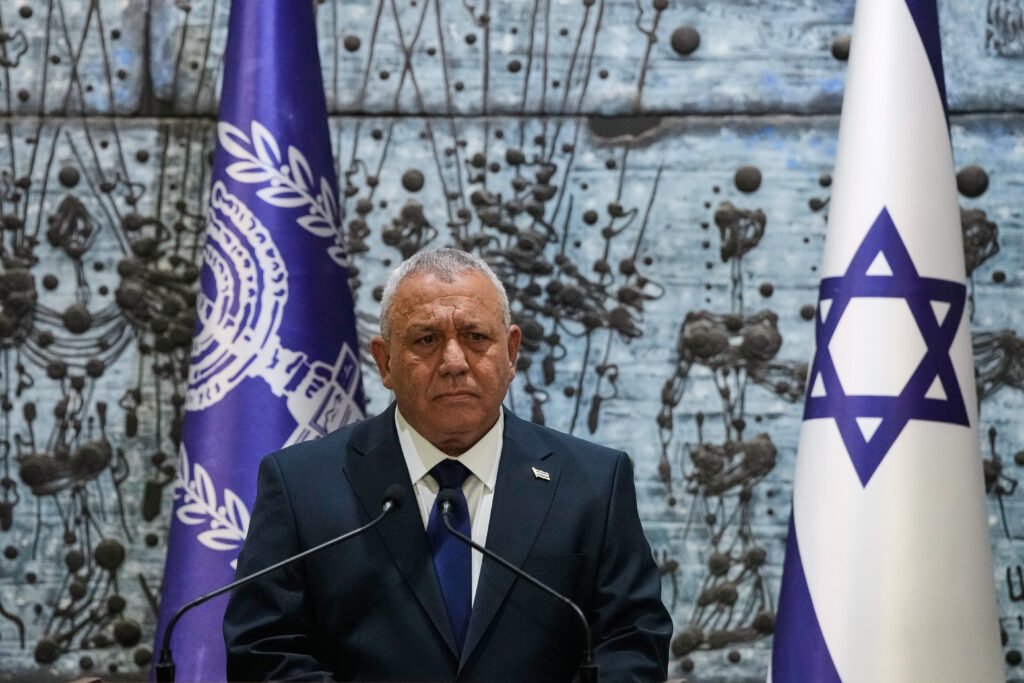
The new Knesset session opens with the opposition leader receiving the mandate to form a government; Eisenkot has outlined plans to reverse key Netanyahu-era policies on judicial reform and coalition governance.
ISRAEL · KNESSET · EISENKOT · GOVERNMENT FORMATION · MIDDLE EAST
The new Israeli parliament was sworn in, and opposition leader Gadi Eisenkot received the mandate to form a government, with Eisenkot outlining an agenda focused on reversing key Netanyahu-era policies, including the contested judicial reform package that generated the largest protest movement in Israeli history, AP and NPR both confirmed on Tuesday. The government formation mandate gives Eisenkot a fixed period under Israeli law to assemble a coalition with sufficient parliamentary support to pass a confidence vote, and his public agenda framing suggests he is positioning the new government as a correction of the direction the Netanyahu coalitions took Israel rather than a continuation of that trajectory.
AP reporting on the Eisenkot agenda provided detail on the specific policy reversals he has outlined. The judicial overhaul that the Netanyahu coalition enacted — which reduced the Supreme Court’s ability to strike down legislation and the professional independence of the attorney general — generated massive sustained protest throughout 2023 and was cited by Israeli voters as a primary motivation for the electoral change. Eisenkot has indicated he will seek to restore the judicial independence that was curtailed, though the specific mechanism and timeline for doing so will depend on the coalition composition he is able to assemble. The agenda also includes modifications to the Netanyahu-era coalition governance arrangements that gave ultra-Orthodox religious parties outsized influence over education and military service exemption policies.
The Coalition Arithmetic
NPR analysis of the coalition arithmetic facing Eisenkot noted the specific challenge of assembling a majority in the Israeli parliamentary system. The Knesset has 120 seats, and a majority government requires 61 seats minimum. Eisenkot bloc — comprising his own National Unity party and center-left allies — has fewer than 61 seats and will need to draw on additional parties to form a majority. The parties available to him include Arab-Israeli parties, whose participation in an Israeli government would be historically significant, and potentially smaller centrist parties that did not align with either the Netanyahu bloc or the opposition during the electoral period. The coalition negotiations are expected to be complex and to take weeks.
AP noted that the Iran war context gives the Eisenkot government formation an international dimension that typical Israeli political transitions do not have. The United States declaration that the Iran war is militarily effectively over occurred simultaneously with the Israeli electoral transition, and the new Israeli government will inherit the security relationship with Washington that was managed by the outgoing Netanyahu administration during the conflict period. The specific Israeli position on the Iran status quo — whether the current pause in kinetic operations is sufficient from an Israeli security perspective or whether Israel wants continued military pressure on Iran — is one of the first security questions the new government will need to address.
“We are here to restore what was broken and build what was missing. Israel deserves a government that serves all its people, not just those who keep the coalition together.” — Gadi Eisenkot, Knesset address cited by AP
Netanyahu Post-Government Status
NPR addressed the status of outgoing Prime Minister Benjamin Netanyahu following the Knesset swearing-in. Netanyahu remains leader of his Likud party and will serve as opposition leader in the new Knesset, maintaining his parliamentary seat and his party leadership. His ongoing corruption trial — which was proceeding in parallel with his government leadership and which critics argued created a conflict of interest — will continue in the courts regardless of his governmental status. Netanyahu’s transition to opposition leader while facing active criminal proceedings creates a distinctive political situation with no clear precedent in Israeli governance history.
WHAT HAPPENS NEXT
► Eisenkot to begin coalition negotiations with potential partner parties; deadline under Israeli law
► Judicial reform reversal legislation to be drafted as first major Eisenkot legislative priority
► Netanyahu to assume opposition leader role; Likud to organize its opposition caucus
► New government to establish Iran security position in consultation with US and regional partners
| CONFIDENCE: HIGH | AP and NPR both confirmed the Knesset swearing-in, the Eisenkot mandate, and the governing agenda outline. Two-source convergence on a confirmed parliamentary event with named leader and stated policy positions. |
| Bias Check | ||
| Left-Lean | Center | Right-Lean |
| Eisenkot agenda framed as democratic restoration after Netanyahu constitutional overreach and corruption. | Reports swearing in, Eisenkot agenda, coalition arithmetic, and Netanyahu status factually. | New government framed with concern about security continuity; Netanyahu policies protected Israeli interests. |
SOURCES
► AP — Israel new Knesset sworn in, Eisenkot mandate, governing agenda, judicial reform reversal, coalition arithmetic, November 11, 2026
► NPR — Netanyahu opposition status, corruption trial continuation, Iran security position, coalition complexity