The second session of US-mediated talks continues with both delegations reporting minimal movement on the core territorial questions; the US framework proposal remains on the table but unaccepted.
DIPLOMACY · UKRAINE · RUSSIA · ABU DHABI · ARC: NOV 10 DAY ONE
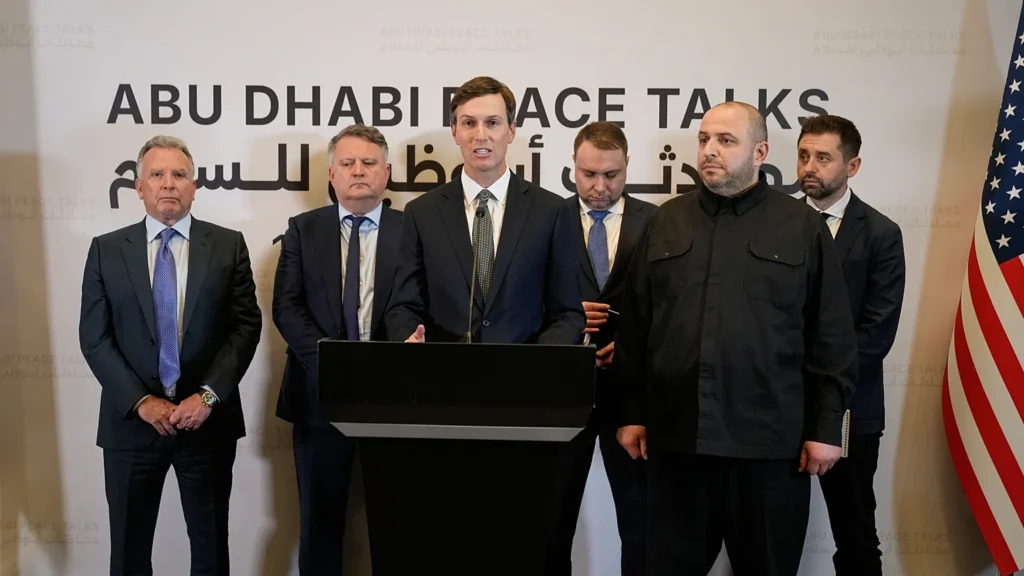
The US-mediated Ukraine-Russia peace talks in Abu Dhabi entered their second day on Tuesday with both delegations reporting limited flexibility on the core territorial questions that have defined the gap between the parties since the first day of talks; Euronews, NPR, and AP all confirmed. The day-two session continued the pattern established in the opening session: Ukraine insisting on territorial restoration as a precondition for any permanent settlement, Russia insisting on recognition of its territorial gains, and the United States pressing both sides toward a ceasefire-first framework that defers the territorial questions without resolving them. No breakthrough was reported by any of the three covering outlets by the time of Tuesday reporting.
Euronews provided the most detailed account of what day-two flexibility — or its absence — looked like on the ground. The Ukraine delegation reportedly presented a modified position on the ceasefire-first framework that added conditions: specifically, that any ceasefire be accompanied by the deployment of a monitoring mission with teeth — not simply observers but a force with the authority and capacity to respond to violations — and that the framework include a binding timeline for the political settlement negotiations rather than an open-ended process in which a ceasefire could become permanent without the territorial question being resolved. The Russian delegation was described by Euronews as rejecting both conditions, characterizing the monitoring force demand as an attempt to introduce a NATO-adjacent force into the conflict zone and the binding timeline as an attempt to impose a political outcome through process.
The US Framework Response
NPR reported that the US delegation responded to the day-two positions by tabling a modified framework that attempts to address the Ukrainian monitoring force concern through a non-NATO multilateral format. The modified US proposal envisions a monitoring mission composed of troops from non-NATO nations — specifically mentioning India and Turkey — that would provide the monitoring presence Ukraine is demanding without the Russian objection to NATO involvement. Whether this modification is sufficient to address the Russian concern was not resolved by the time of Tuesday reporting.
AP noted that the second day of the Abu Dhabi talks coincides with the arrest of a US Army soldier suspected of spying for Russia, a development that creates counterintelligence complications for the US negotiating team. If Russian intelligence has penetrated the American side of the talks, the security of the negotiating positions and framework modifications being discussed in Abu Dhabi is compromised, and the US delegation must balance the need to continue engaging with the awareness that the opposing side may have additional information about the American position. AP reported that the US delegation had been briefed on the arrest and that security protocols were being reviewed.
“Day two is when you find out if the first day was a beginning or a performance. We are still finding out.” — Diplomatic source familiar with the talks, cited by Euronews
The European Observer Dimension
Euronews reported that European diplomatic observers monitoring the talks from outside the formal delegation structure were growing more concerned after day two about the fundamental gap between the parties. The European assessment — consistent with the concern reported after day one — is that the US ceasefire-first framework creates a structural problem that grows rather than shrinks over time: the longer a ceasefire holds without a political settlement, the more difficult it becomes to reopen the territorial question, as frozen conflict lines tend to become de facto recognized borders. The European preference for a framework that addresses the territorial question before the ceasefire becomes permanent is not being reflected in the US proposal, and European observers were described as feeling increasingly sidelined from a process that affects their immediate security environment.
WHAT HAPPENS NEXT
► Abu Dhabi talks to continue; day-three agenda to test modified US framework with monitoring mission proposal
► Indian and Turkish governments to be consulted on willingness to participate in monitoring force
► US delegation to assess security protocols following NATO espionage arrest
► Trump APEC meeting with Putin to potentially accelerate Abu Dhabi framework
| CONFIDENCE: HIGH | Euronews, NPR, and AP all confirmed the day-two talks, the limited flexibility pattern, and the modified US framework proposal. Three-source convergence on a confirmed and ongoing diplomatic process with specific position details. |
| Bias Check | ||
| Left-Lean | Center | Right-Lean |
| Day-two stalemate framed as US framework protecting Russian territorial gains under ceasefire-first cover. | Reports day-two positions, modified US framework, and European observer concerns factually. | Day-two talks framed as difficult but productive process; getting to ceasefire is itself a significant achievement. |
SOURCES
► Euronews — Abu Dhabi day two, limited flexibility, Ukrainian monitoring force demand, Russian rejection, November 11, 2026
► NPR — Modified US framework, non-NATO monitoring mission proposal, India and Turkey role
► AP — Espionage arrest impact on negotiating security, day-two briefings, US delegation protocol review