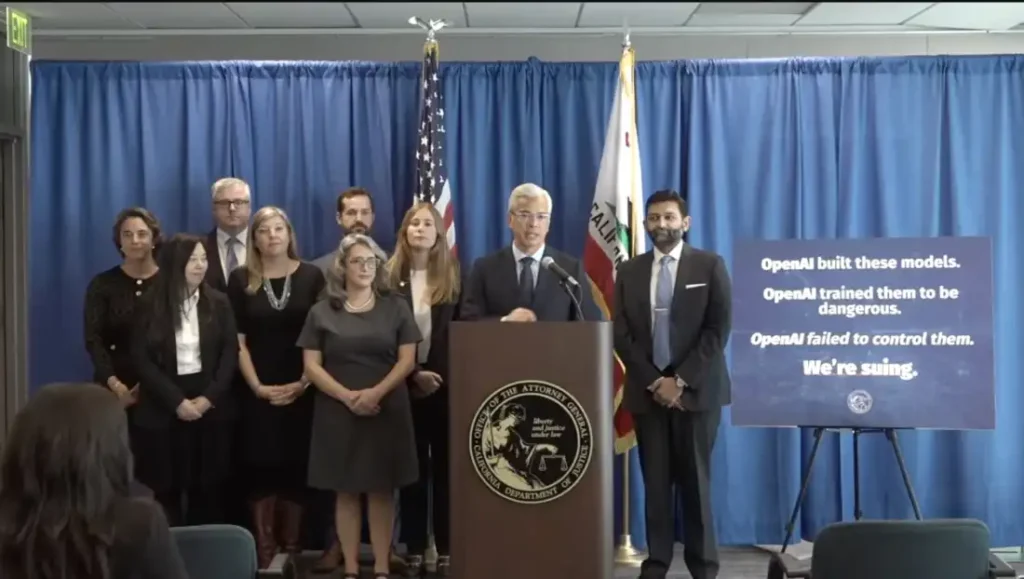
California Attorney General filed a lawsuit against OpenAI, alleging the company misled the public and regulators about the safety of its artificial intelligence products, the most significant state-level legal action against a leading AI developer.
LEGAL · CALIFORNIA · OPENAI · PRODUCT SAFETY · MISLEADING CLAIMS · AI REGULATION
The California Attorney General filed a lawsuit against OpenAI alleging that the company misled the public and regulators about the safety of its artificial intelligence products, NPR confirmed on Monday, in the most significant state-level regulatory action against a leading AI developer and a potentially consequential legal test of whether existing consumer protection and false advertising law can be applied to claims made by AI companies about the safety characteristics of their technology. The California lawsuit arrives in the specific regulatory context created by the absence of comprehensive federal AI regulation: Congress has not passed AI-specific safety legislation, the federal regulatory agencies have been developing AI frameworks under existing authority with limited enforcement reach, and the California Attorney General filing represents the most aggressive use of state consumer protection authority to fill the federal regulatory gap. The specific allegations — that OpenAI misled the public and regulators about product safety — target the claims that OpenAI has made in public communications, congressional testimony, and regulatory filings about the safety measures incorporated into its AI systems.
NPR provided context on the specific legal theory of the California lawsuit. Consumer protection and false advertising law — the statutory framework most likely being used by the California Attorney General — prohibits companies from making material misrepresentations about their products to consumers or regulators. Applied to AI safety claims, the theory would be that OpenAI represented to the public that its AI systems had specific safety features, that those representations were false or misleading in ways that were material to consumers’ decisions about whether and how to use the products, and that OpenAI knew or should have known the representations were false when made. NPR noted that the specific allegations in the complaint — the precise statements OpenAI made and the specific ways in which the California Attorney General alleges they were misleading — will be the central factual and legal contest in the litigation.
The Regulatory Gap Context
NPR analyzed the regulatory gap context that makes the California lawsuit significant beyond the specific OpenAI dispute. The absence of federal AI safety regulation has left AI companies operating under a patchwork of existing laws — consumer protection, securities regulation, product liability — that were not designed with AI systems in mind and that do not address the specific safety challenges of AI products: the difficulty of predicting AI system behavior in deployment, the challenge of testing AI systems against the full range of real-world inputs, and the gap between claims made in controlled testing environments and system behavior in actual use. The California lawsuit is testing whether existing consumer protection law can bridge that regulatory gap by holding AI companies accountable for safety claims that do not accurately describe the systems as deployed.
NPR noted the specific significance of California as the state filing the lawsuit. California is home to the major AI companies — OpenAI, Anthropic, Google DeepMind, Meta AI — and the California Attorney General filing an AI safety lawsuit creates a regulatory dynamic in which the most AI-concentrated state in the country is asserting regulatory authority over an industry that has largely governed itself through voluntary commitments. If the California lawsuit is successful — either through a court judgment or a settlement that includes substantial compliance commitments — it will establish legal precedent and practical norms for AI safety disclosure that may be more consequential than any federal regulation currently under development. NPR noted that OpenAI has committed to defending the lawsuit and that the company disputes the characterization of its safety claims as misleading.
“OpenAI told the public its products were safe. We are alleging that the evidence shows otherwise. The law does not permit companies to mislead consumers about the safety of their products, regardless of how advanced those products are.” — California Attorney General statement cited by NPR
The Anthropic IPO Connection
NPR noted the connection between the California OpenAI lawsuit and the anticipated Anthropic IPO (tracked from Nov 16 on Nvidia earnings and Anthropic IPO watch). A state attorney general lawsuit against the leading AI developer — specifically targeting safety claims — lands in the week when Anthropic, the AI safety company, is anticipated to access public markets. The juxtaposition creates a specific narrative: OpenAI, the AI company that has been criticized by former employees and researchers for subordinating safety to commercial pressure, is being sued for misleading safety claims at the same moment that Anthropic, founded specifically to pursue a safety-first approach to AI development, is pursuing a public debut that is expected to be received as a vindication of the safety-focused approach. NPR noted that the California lawsuit may affect how public market investors assess the AI sector broadly and the safety-first versus safety-as-marketing distinction specifically.
WHAT HAPPENS NEXT
► OpenAI to respond to the California lawsuit; legal team to file initial response in state court
► Specific allegations in the complaint to be examined; which OpenAI safety claims are alleged to be misleading
► Other state attorneys general to assess whether to file similar suits; California action may be a template
► Federal regulatory response to be assessed; whether the California lawsuit catalyzes federal action
► Anthropic IPO to be assessed in context of California OpenAI safety suit; AI sector safety credibility at stake
| CONFIDENCE: HIGH | NPR confirmed the California Attorney General lawsuit against OpenAI, the misleading safety claims allegation, and the regulatory gap context. Single public broadcaster on a confirmed court filing of significant legal and regulatory consequence. |
| Bias Check | ||
| Left-Lean | Center | Right-Lean |
| Lawsuit framed as justified accountability; OpenAI has consistently overstated safety while racing to commercialize. | Reports California lawsuit, legal theory, regulatory gap context, California significance, and Anthropic IPO connection factually. | Lawsuit framed as regulatory overreach; existing consumer protection law is not designed for AI and California is acting beyond its authority. |
SOURCES
► NPR — California lawsuit confirmation, legal theory analysis, regulatory gap context, Anthropic IPO connection, November 17, 2026