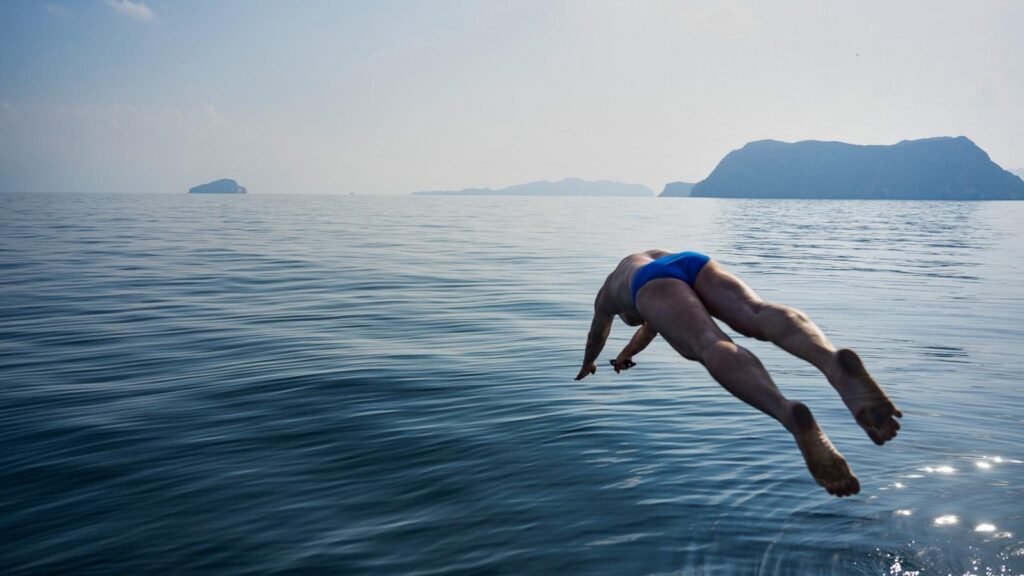
An athlete completed a swim across the Strait of Hormuz as a symbolic protest against the environmental impact of the Iran war on regional wildlife and marine ecosystems, drawing attention to a dimension of the conflict that has received limited coverage in mainstream crisis reporting.
STRAIT OF HORMUZ · SWIM · PROTEST · IRAN WAR · WILDLIFE · ENVIRONMENTAL · SYMBOLIC
An athlete completed a swim across the Strait of Hormuz — one of the most strategically significant bodies of water in the world, through which approximately 20 percent of global oil supply passes — as a symbolic environmental protest against the impact of the ongoing Iran conflict on regional wildlife and marine ecosystems, CBS News reported on Saturday. The swim, which CBS News characterized as a symbolic protest amid ongoing conflict, draws attention to a dimension of the Iran war that has received comparatively limited coverage in the dominant crisis reporting framework: the environmental and ecological consequences of the military operations, naval activity, and infrastructure damage that have accompanied the conflict in the Persian Gulf and Strait of Hormuz region. The specific athlete, the distance completed, and the specific environmental concerns highlighted by the protest were confirmed in CBS News reporting.
CBS News provided context on the environmental impact of conflict in the Strait of Hormuz region. The Persian Gulf is one of the world’s most environmentally sensitive marine environments: its shallow, warm, and semi-enclosed waters host unique coral reef ecosystems, significant fisheries, and marine mammal populations including dolphins, dugongs, and several species of sea turtle. The military activity associated with the Iran conflict — naval operations, air strikes on coastal and island facilities, potential fuel spills from damaged vessels, and the general disruption of normal shipping and fishing patterns — creates specific environmental stressors for the Gulf marine ecosystem. CBS News noted that environmental monitoring in an active conflict zone is extremely difficult, and that the full environmental impact of the Iran war on Gulf marine ecosystems will not be known until after the conflict ends and assessment missions can operate.
The Symbolic Dimension
CBS News analyzed the symbolic dimension of the Hormuz swim protest. The choice of the Strait of Hormuz as a protest location is multiply symbolic: the Strait is the economic jugular of the global oil system (a closure or significant disruption of Hormuz transit would trigger an immediate global energy crisis), it is the specific waterway through which military vessels from multiple nations have been transiting as part of the Iran confrontation, and it is the boundary between the Persian Gulf — where the conflict impact is most concentrated — and the Arabian Sea. A swim across the Strait by an athlete as a protest act draws simultaneous attention to the environmental cost, the strategic stakes, and the human capacity for small acts of statement in the face of overwhelming geopolitical forces. CBS News noted that the protest was intended to generate international attention to the wildlife dimension of the Iran conflict.
“The fish and the turtles and the coral do not care about geopolitics. They are dying in a war they did not start.” — Athlete cited by CBS News on the Hormuz swim protest
The Iran Arc Connection
CBS News placed the Hormuz swim in the broader Iran arc that ONYX has tracked across multiple editions. The Iran conflict — which ONYX has covered from the November 17 dirty bomb intelligence through the three-carrier deployment, the Houthi-Saudi nuclear pact complications, and the broader regional security architecture — has been covered primarily through its strategic and security dimensions. The environmental protest at the Strait of Hormuz represents a reminder that the conflict has ecological as well as strategic dimensions, and that the marine ecosystems of the Persian Gulf and the communities that depend on fishing and coastal environments in the Gulf region are bearing costs that do not appear in the geopolitical analysis. CBS News noted that the Iran conflict’s environmental impact is a subject that environmental organizations and scientists have been attempting to highlight throughout the conflict.
WHAT HAPPENS NEXT
► Environmental assessment missions to plan post-conflict access to Gulf marine areas; baseline damage to be established
► Wildlife and conservation organizations to maintain pressure on conflict parties to minimize environmental damage
► International media coverage of the Iran war environmental dimension to be assessed; whether the protest generates follow-on reporting
| CONFIDENCE: MODERATE | CBS News confirmed the Hormuz swim, the environmental protest framing, and the Iran conflict wildlife context. Single source on a confirmed symbolic protest event — moderate confidence reflects the single-source structure and the inherently small-scale nature of a protest action. |
| Bias Check | ||
| Left-Lean | Center | Right-Lean |
| Protest framed as urgent reminder that war destroys nature; the Iran conflict is an environmental catastrophe that the security-focused media ignores. | Reports the swim, the environmental protest context, the Hormuz symbolic significance, and the Iran arc connection factually. | Protest framed as misplaced priorities; the wildlife concern is legitimate but the military operations are necessary responses to Iranian aggression and cannot be held hostage to environmental objections. |
SOURCES
► CBS News — Swim confirmation, environmental protest context, Strait of Hormuz significance, Iran arc connection, November 22, 2026