About 80 masked Israeli settlers attacked Palestinians during the annual olive harvest in Abu Falah, injuring at least two people, including a journalist. The harvest is both livelihood and identity. Its disruption is not incidental.
BREAKING · WEST BANK · SETTLER VIOLENCE
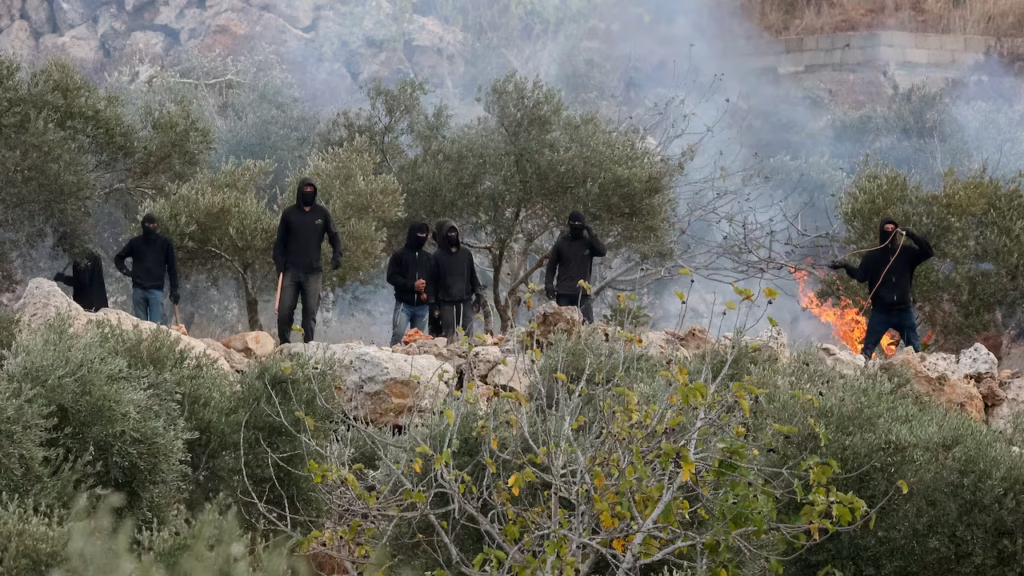
ABU FALAH, WEST BANK — The olive harvest is the economic anchor of Palestinian village life — the weeks each October when families move into the groves they have tended for generations and gather the crop that sustains them through the year. On Thursday, approximately 80 masked Israeli settlers arrived at the groves near Abu Falah and attacked the pickers, injuring at least two people, including a journalist covering the harvest, before setting fire to olive trees.
The attack was confirmed by Reuters and corroborated by the Palestinian Red Crescent, which said it dispatched medical teams to the area. The Israeli Defense Forces, which are responsible for security in the area, had not publicly commented on the incident as of Thursday evening. No arrests had been reported.
The Harvest as Flashpoint
Settler attacks on Palestinian olive harvests have been a recurring feature of the West Bank autumn for years, documented by human rights organizations including B’Tselem and Amnesty International. The harvest season is particularly tense because it draws Palestinian families into areas where their presence is contested — and where settlers have historically acted with limited interference from Israeli security forces.
The Abu Falah attack follows a summer in which settler violence in the West Bank reached levels that even U.S. officials described as unacceptable. The Biden administration had sanctioned specific settler individuals; the Trump administration reversed those sanctions earlier this year, a move that critics said removed a key accountability tool.
“They came with masks and fire. We came with baskets. This is our harvest, our land, our year.” — Palestinian farmer, speaking to Reuters from Abu Falah
The Journalist Among the Injured
The injury of a journalist — reported by Reuters as among the two wounded — adds a dimension beyond the immediate attack. International press organizations have documented the increasing difficulty of covering settler violence in the West Bank, where access is sometimes physically blocked and where journalists have themselves been targeted. The identity and condition of the injured reporter had not been officially confirmed as of Thursday evening.
WHAT HAPPENS NEXT
► UN Special Coordinator for the Middle East Peace Process expected to condemn; calls for IDF action likely.
► European Union has been pressing Israel on settler accountability — this attack will intensify that pressure.
► Palestinian Authority filing a formal complaint with the International Criminal Court.
► Olive harvest season continues for several more weeks — risk of additional incidents remains high.
► U.S. State Department position under scrutiny given the reversal of Biden-era settler sanctions.
| CONFIDENCE: HIGH | Attack confirmed by Reuters. Palestinian Red Crescent medical response corroborated. Journalist injury reported by Reuters; identity not yet officially confirmed. Settler violence context drawn from documented human rights reporting. |
| Bias Check | ||
| Left-Lean | Center | Right-Lean |
| Frames as systematic Israeli government-backed dispossession. | Reports the attack, the injuries, and the pattern of settler violence as documented. | Minimal coverage; when covered, frames as an isolated incident unrelated to policy. |
| Assessment | ONYX presents confirmed facts and documented context. No editorial stance on the conflict. | |
SOURCES
► Reuters — Confirmed attack on Abu Falah olive harvest; casualty details
► Palestinian Red Crescent — Medical response confirmation